
~~~
Nutrition as Therapy:
Unlocking the Healing Power of Food for Body, Brain, and Mind
Nutritional deficits cause physical and mental illnesses and behavioural malfunctions
By Renata Taylor-Byrne
~~~
Edited by Jim Byrne
~~~
E-Cent Institute Publications, Hebden Bridge, February 2026
~~~
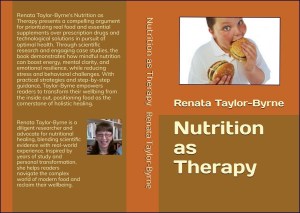
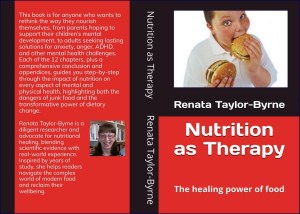
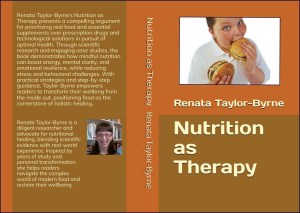
 After two years of hard work by Renata, this helpful guide to what to eat and what to avoid, for good mental and physical health, is at last available.
On this page, we will present some insights into the content of the book:
But if you prefer, you can go to Amazon and read the book description there:
– Nutrition as Therapy: The paperback book.***
Foreword
By Jim Byrne, Doctor of Counselling
~~~
 This book explores the profound connection between nutrition and health. Or, to be more precise, it examines the causal links between two factors:
- real foods and nutritional supplements (on the one hand);
- and mental and physical health (as a con-sequence of nutritional states).
The author highlights how dietary choices directly impact the body, brain, and mind.
Drawing on historical research, case studies, and contemporary scientific findings, the book emphasizes that many mental health issues – such as anxiety, depression, ADHD, addictions, and even severe psychiatric conditions – can be influenced or alleviated by proper nutritional diets and supplementation.
The introductory chapters recount personal revelations and landmark experiments, such as the Minnesota starvation study, to illustrate how nutrient deprivation leads to dramatic psychological and physiological changes. The author critiques the traditional medical model’s neglect of nutrition in favour of pharma-ceutical treatments, and describes the stigma around mental health as often rooted in misunderstandings about the biological necessity of nutrients.
More than forty case studies are presented, which illustrate how individuals suffering from a wide range of physical and mental health problems – some resistant to conventional medications – have experi-enced significant recovery after dietary changes or the introduction of multinutrient supplements. And some of those studies involved scientific study of nutritional interventions with large groups, over long periods of time.
The book describes pioneering work by doctors and researchers, including Drs George Watson, Julia Rucklidge, and Bonnie Kaplan, who have shown that broad-spectrum micro-nutrients can transform out-comes for conditions like anxiety, depression, bipolar disorder, schizophrenia, ADHD, and aggression in children and adults.
 The impact of nutrition on children’s cognitive development and academic performance is high-lighted, with evidence that diets rich in vitamins, minerals, and whole foods can boost IQ, improve behaviour, and reduce aggression. International inter-ventions, such as those by UNICEF, further demon-strate the benefits of micro-nutrient supplementation in improving maternal and infant health outcomes.
The book also examines how poor dietary choices – such as high consumption of trans-fats, sugar, processed foods, gluten, alcohol and caffeine – can damage mental and physical wellbeing, leading to increased risk for chronic diseases, inflammation, emotional distress, and addiction. Conversely, it advocates for the protective and restorative effects of healthy diets, such as the Mediterranean and MIND diets, and the importance of omega-3 fatty acids, magnesium, B vitamins, and regular multinutrient supplementation.
Chapters dedicated to anxiety, depression, and addiction explain the biological mechanisms by which nutrition affects neuro-transmitters, gut health, in-flammation, and stress responses. The book presents research showing that nutritional interventions can aid in recovery from trauma, reduce the severity of stress and post-traumatic symptoms, and outperform some standard medical treatments in certain cases.
The final section recommend a holistic approach to health, by integrating nutrition with lifestyle factors like sleep and exercise.
The book concludes by urging readers to become informed and proactive about their dietary choices, as these directly influence not only their own health and happiness but also that of their families and whole communities.
There is then an Afterword and three Appendices on the new scientific understanding of the processes involved in the causation and cure of mental illnesses and emotional and cognitive problems.
In summary, the book demonstrates that eating real, nutrient-dense food supported by targeted supple-mentation are foundational strategies for rebuilding and maintaining optimal body, brain, and mind health – offering hope and practical guidance for addressing both everyday health problems – and severe mental and physical health challenges – through proper nutrition, based on real, wholesome foods, plus essen-tial nutritional supplements.
I recommend this book to everybody who cares about the physical and mental health of themselves and their nearest and dearest; plus the health of whole communities.
~~~
Jim Byrne, Doctor of Counselling, February 2026
~~~
Contents
Foreword…………………………………………………. xi
Preface…………………………………………………. xvii
Chapter 1: Introduction………………………………… 1
Chapter 2: The field of nutrition for health…………. 13
Chapter 3: The destructive effects of poor nutrition on mental well-being 25
Chapter 4: Nutritional research with babies, children, teenagers and young adults 43
Chapter 5: Why we need nutritious foods and supplements 65
Chapter 6: How diet and nutrition affect anxiety and stress emotions 99
Chapter 7: Depression and nutrition………………. 117
Chapter 8: Nutrition can reduce addiction to alcohol, smoking, and drugs 135
Chapter 9: Foods to Avoid…………………………… 151
Chapter 10: The best foods to eat for good physical and mental health 197
Chapter 11: Why don’t we know more about how food affects our bodies and minds?………………………………………………………….. 213
Chapter 12: Nutrition is important, but so are other lifestyle factors 231
Chapter 13: Conclusion……………………………… 243
Afterword………………………………………………. 247
References…………………………………………….. 251
Appendix A: Summary of a key text on the science of nutrition for mental health 265
Appendix B: Understanding the Science of Nutrition for Good Mental Health: 269
Appendix C: Nutrients act as co-factors…………… 283
Endnotes……………………………………………….. 285
~~~
To see this book online, at an Amazon outlet near you, please click one of the following links.
~~~
~~~
~~~
Preface
By Renata Taylor-Byrne
February 2026
~~~
Unlocking Better Health – One Bite at a Time
Are you searching for a real solution to lasting mental and physical wellness? This book is your essential guide to understanding how what you eat truly shapes your body, your brain, and your life. Drawing from compelling scientific research, personal break-throughs, and dramatic case studies, it reveals how anxiety, depression, ADHD, addiction, and even severe psychiatric challenges can often be improved – sometimes dramatically – by adopting real food and targeted nutritional supplements.
Forget quick fixes and mere symptom management. Inside, you’ll discover the stories of individuals who recovered from mental illnesses and behavioural mal-functioning when traditional treatments failed, thanks to the life-changing power of nutrition. Plus studies of whole-group improvements in scientific studies.
Learn about influential pioneers in the field whose work proves that the right diet and micronutrients can boost children’s intelligence, improve behaviour, and promote emotional stability for all ages.
This book doesn’t just highlight the dangers of processed foods, sugar, and unhealthy habits – it equips you with actionable strategies, including the best diets and essential supplements, to help you reclaim your health and happiness.
You’ll see how nutrition affects everything from stress resilience and trauma recovery to inflammation and daily energy.
If you’re ready to take control – whether for yourself, your family, or your community – this book is your invitation to a new, empowered life. Let food be your medicine, and discover hope, healing, and lasting vitality. Dive in and start your transformation today!
~~~
Renata Taylor-Byrne, Hebden Bridge, February 2026
~~~
To see this book online, at an Amazon outlet near you, please click one of the following links.
~~~
~~~
~~~
Chapter 1: Introduction
By Renata Taylor-Byrne
~~~
“There is a big problem with vitamins. Our bodies can’t make most of them. We, and that includes our brains, are completely at the mercy of our diet.”
Professor James Godwin[i]
~~~
My goal for this book is to show you what I have discovered from doctors, nutritionists, food specialists and researchers about what our bodies need in order to function effectively, so that you can increase your physical and mental health, and happiness, and your sense of control over your life.
~~~
I began this research in 2015/2026, and published my first book on the subject in 2017.
Then, two years ago (in 2024), I discovered a book which had escaped my earlier research efforts; and this new book explained very vividly – and with case studies – the effects that lack of food, or the wrong kind of food, will predictably have on the body and the mind. These “nutritional secrets” were described by Dr George Watson, in his book, Nutrition and Your Mind, which was first published in 1972.[ii]
The case studies he described in his book show very clearly that our physical and mental health depend upon the nutritional value of the foods we eat, combined with any nutritional supplements we may take.
His revelations went beyond the findings of my desktop research on this subject, conducted in the period 2015-2017.[iii]
And then I went back to my original sources, and added some more. The references list at the back of this book shows that the conclusions of this book are based on considering the evidence presented in at least thirty-five books and more than seventy articles! And I have spent more than two years chewing through all of that material, in order to produce this book you hold in your hands.
~~~
The Problem with Vitamins and Nutrition
The quote from Professor James Godwin above, high- lights a fundamental issue: The human body cannot produce most vitamins, making it entirely dependent on diet for essential nutrients, including those needed for brain function.
~~~
Historical and Scientific Context
Building upon my earlier research into diet, exercise, and mental health – in 2015-2027[iv] – I gradually realized that Dr Watson’s case studies built up a richer picture of how inadequate diets cause many mental afflictions and addictions, often misunderstood by medical professionals, leading to stigma and loss of physical freedom for sufferers.
The Minnesota Starvation Experiment of the 1950s[v] had revealed, at an early date, that starvation (or consumption of inadequate nutrition) induced severe psychological effects – such as apathy, depression, hysteria, and loss of concentration – among starvation research volunteers. This underscores the conclusion that mental health issues linked to nutrition should not carry stigma, as they can be addressed by improving diet, gut health, and stress management.
~~~
Early Recognition of Physical-Mental Health Link
As early as the 1890s, Sigmund Freud emphasized the importance of physical examinations before psycho-analysis, recognizing the connection between physical and mental health, an approach now supported by evidence linking nutrition and biochemistry to mental states.
Despite awareness of starvation research, mainstream psychology has largely neglected clients’ diets in mental health treatment.
~~~
Impact of Poor Diet on Emotional Health
Poor diets, such as those high in junk food, trans-fats, and sugar, are equivalent to semi-starvation in nutritional terms, and have been linked to emotional disturbances, including angry outbursts, anxiety and depression.[vi] And of course, physical disease is also linked to nutritional deficiency[vii].
~~~
Case Studies that Shock
One of the first and most dramatic case studies from Dr Watson illustrates how a woman experienced panic attacks linked to low blood sugar caused by a faddish low-carbohydrate diet.
Her symptoms included fear, inability to speak, and emotional distress – causing her to leave her home in tears and walk into the traffic, almost getting killed in the process. And these symptoms were alleviated after consuming a drink containing brandy, sugar, and water, which quickly raised her blood glucose levels. (I am not here recommending the consumption of either brandy or sugar. There are safer and better ways to raise your blood glucose to a moderate and stable level!)
The cause of her mental distress and self-destructive behaviour was identified as insufficient glucose for brain function, impairing emotional control.
Adjusting her diet resolved the panic attacks.
~~~
Of course, the opposite problem can also occur, as observed in our clinical practice, at ABC Counselling and Psychotherapy Services. Some clients present with social and generalized anxiety, because of their high consumption of sugary drinks. It is the extremes that we need to avoid – too high or too low – and the diet recommended by Glucose Revolution is a good “middle way”! (Inchauspe, 2022; listed in the references, below).
Glucose is a two-edged sword!
Jessie Inchauspe, in her work “Glucose Revolution,” explains that glucose is essential for the body as it serves as a primary energy source for our cells. However, she emphasizes that while glucose is necessary, its levels must be carefully managed – a classic example of a two-edged sword.
On one hand, we need glucose for energy, mental clarity, and overall bodily function.
On the other hand, frequent or excessive spikes – or big increases – in glucose ingestion can lead to increased insulin[1] production, which not only makes weight loss difficult but also contributes to a range of health problems, including diabetes, obesity, and even mental health issues.
We should strive to avoid sharp spikes (increases) in blood glucose levels, by adopting practical strategies, such as
- eating vegetables before other foods,
- taking a teaspoon of vinegar before each meal, mixed with a glass of water
- choosing whole grains,
- and by exercising after meals.
By doing so, we harness the benefits of glucose for energy and health, while minimizing the risks associated with poor glucose control.
This perspective underscores that glucose, while vital, must be respected and managed properly for optimal well-being.
~~~
~~~
Nutritional depletion and psychosis
Even more dramatic than that was the case of Autumn Stringham, a young woman who experienced psychosis after the birth of her second child, resulting in her children being taken away from her, and a medical diagnosis that she would need to be on anti-psychotic medication for the rest of her life. Her husband disagreed, and set out to develop a nutritional solution to her problems. In time, as she began to take a strong, broad-spectrum multinutrient supplement, Autumn returned to normal mental health; got her children back; and was able to give up the anti-psychotic medication. (So much for the reliability of psychiatric medical diagnoses!) This case study is presented in more detail later in this book.
And then there was Donald – whose mother famously said, “Donald loves his hamburgers!” Donald liked his hamburgers so much that his daily diet was ham-burgers and coffee; everyday; with no variation. Of course, he became so anxious that he could not bear to be in small spaces, and the quality of his life was seriously compromised – until Dr Watson advised him to change his diet; and the anxiety “mysteriously” disappeared!
“Food as recreation” is a big problem in the Western world today.
Food should be treated as essential medication; with a recognition that the human body needs a compre-hensive range of essential nutrients in order to be physically and mentally healthy!
That is to say, the human body is like a chemical factory, which is charged with producing particular outputs every day: energy and activity, thinking and feeling capacity, and so on. But those outputs depend on the inputs to the “factory”. Just as in industry, and information technology, the principle of “garbage in – garbage out” applies. Junk food produces malfunction-ing of the human “chemical factory”!
If you want your body, brain and mind to functional well, you need to input the right kinds of foods and nutritional supplements!
~~~
Broader Implications of Nutritional Research
Inspired by these scientific research findings, I expanded my 2015-2017 research to include evidence from several new sources, supporting the case for diets based on real food, essential nutritional supple-ments, and avoidance of harmful additives in pro-cessed foods and drinks.
Nutrients are shown to enhance mental ability from childhood through adulthood and can positively affect various mental health conditions including anxiety, anger, depression, ADHD, addictions, schizophrenia, psychosis, and other conditions. More than that, they are actually essential for optimal functioning of the body, brain and mind.
~~~
Critique of Mainstream Medicine and Public Awareness
In this book I will present a critique of mainstream medicine for favouring prescription drugs and techno-logical solutions over nutritional approaches, despite the evidence of the healing power of nutrition.
It seems that many people – including many medical practitioners – are unaware of the significance of what they consume (in the name of food and drink) and how it impacts their health, pointing to the dangers from ultra-processed foods and sugary drinks, along with manipulative marketing strategies by processed food manufacturers.
~~~
Summary of Key Themes and Hopes for Readers
Almost two years ago, I set out to research and write this book, with the following research plan in mind: I will explore…
- The power of food to influence health
- The role of nutrients in boosting energy
- Nutritional strategies to reduce addictions
- Enhancing mental ability and stamina through nutrition
- The capacity of nutrition to reduce stress, increase self-confidence, and improve our behaviour management
- Evidence supporting healthy diets for illness prevention
- Nutritionally optimal diets
I do hope that my readers will gain valuable insights into the crucial role of nutrition in physical and mental health and healing.
~~~
This book contains 12 chapters – (plus a conclusion) – each examining a different aspect of the impact of nutrition on body and mind. Early chapters highlight case studies illustrating how poor nutrition or ex-posure to harmful substances can lead to severe physical and mental health problems, while subse-quent chapters showcase the healing power of dietary changes and targeted nutrient therapy.
The content of those chapters will be reviewed in Chapter 2, next, below.
And after Chapter 13, I have included an Afterword, and three Appendices, to clarify the scientific theories underlying the concept of nutrition as therapy for the body, brain and mind.
~~~
Renata Taylor-Byrne
Hebden Bridge, February 2026
~~~
Endnotes
[1] Insulin is a hormone produced by the pancreas that helps regulate blood sugar levels by allowing glucose to enter cells for energy. It plays a crucial role in converting food into energy and maintaining overall metabolic balance in the body.
[i] Goodwin, James (2022) “Supercharge Your Brain: How to maintain a healthy brain throughout your life. London: Penguin Random House UK.
[ii] Watson, G. (1974) Nutrition and Your Mind. New York: Bantam Books.
[iii] Taylor-Byrne, R.E. and Byrne, J.W. (2017) How to control your anger, anxiety and depression, using nutrition and physical activity. Hebden Bridge: The Institute for E-CENT Publications.
[iv] Taylor-Byrne, R.E. and Byrne, J.W. (2017) How to control your anger, anxiety and depression, using nutrition and physical activity. As above…
[v] Kaplan, B.J., Julia J. Rucklidge, Amy Romijn, and Kevin Flood (2015) The emerging field of nutritional mental health: Inflammation, the microbiome, oxidative stress, and mitochondrial function. Clinical Psychological Science, Vol.3 (6): 964-980. (Cited in Taylor-Byrne and Byrne, 2017).
[vi] Taylor-Byrne, R.E. and Byrne, J.W. (2017) How to control your anger, anxiety and depression, using nutrition and physical activity. As above…
[vii] There is a growing recognition that poor nutrition can lead to various physical illnesses, including chronic diseases like heart disease, diabetes, and obesity. Studies have shown that inadequate nutrition significantly impacts overall health and can increase the risk of multiple medical conditions. (Sources)
~~~
To see this book online, at an Amazon outlet near you, please click one of the following links.
~~~
~~~
~~~

 ABC Bookstore Online UK