
~~~
Blog post – 6th August 2021
Childhood Developmental Trauma and how to heal yourself
By Dr Jim Byrne, Doctor of Counselling, and Trauma Survivor
~~~
Introduction
 Trauma is all around us. Many humans are seriously damaged by their families of origin, and by their cruel cultures.
It is no accident that I got into developing various approaches to trauma therapy. No surprise that I became a psychotherapist, and worked hard to help many individuals to recover from the pain, confusion and loneliness of Childhood Developmental Trauma (or Complex-PTSD).
I got into this line of work because – without knowing it at the time – I am actually a Childhood Developmental Trauma survivor.
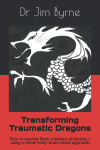
And I am making great progress – slowly – with my new book on Childhood Developmental Trauma, which is titled: Transforming Traumatic Dragons: How to recover from a history of trauma – using a whole body-brain-mind approach. Revised, expanded and updated: August 2021.
That book is now very close to being completed. I have finished the writing and editing. At the moment I am proofreading the text – and I am on page 159 out of 421, which is approximately a third of the way through – (or 37%).
When I have finished, it will be proofed by Renata Taylor-Byrne, my co-author. And then it will be published and made available via Amazon outlets.
Of course, I did publish an earlier, less developed book on this topic, which had two of the three processes that I present in the current book – but the current book is vastly superior, because of the addition of the ‘interoceptive Windows model’, which integrates writing therapy and body work, with breath work, and EMDR. (Plus additional insights into trauma and diet; trauma and exercise; trauma and sleep; how precisely to do that [writing therapy combined with body work] process; and so on).
This book should be a great help to many individuals who have the determination to do at least some of their own therapy at home; perhaps combined with some face to face counselling and therapy with a trauma therapist, because the interpersonal, right-brain to right-brain aspect of trauma recovery is so very important.
~~~
My own trauma journey
Of course, long before I got down to writing about the trauma problems of other people, I had to work on my own childhood trauma damage. One of the ways that I did that was to write my own autobiographical stories about my origins and my ‘relationships’.
One of the main ways I did this work was to create an ‘alter ego’ – who I named ‘Daniel O’Beeve’. I then (in my mind) put Daniel into those situations through which I have lived, and which I could dredge up from my memory banks; and I observed how he got on – from the ‘outside’ – (objectification!). I then retrieved a lot of my old traumatic nightmares, and rewrote them in a literary style. And then I created a set of ‘alien psychologists’ who could observe Daniel’s journey, through a “wormhole in space-time”, and to make comments about how to understand what is going on in his life (using psychological concepts), in a way which Daniel and I could never have commented! (Clearly this has to be called “a fictionalized autobiographical story”; and none of the characters in this story should be confused with any real individual, living or dead!)
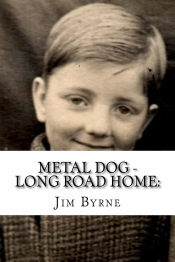
I published all of that work in a book called Metal Dog – Long Road Home. And this is the Amazon books description of that book:
Book description
Daniel O’Beeve was a victim of childhood developmental trauma, before anybody had even thought to conceive of such a concept. He was a victim of abuse and neglect long before anybody gave a damn about the emotional welfare of children.
Daniel’s parents were both born into highly dysfunctional families; poor rural families that lived from hand to mouth; families who had been trained by the priests to “beat the fear of God” into their children.
Daniel’s parents did not love each other. They had an arranged marriage, and never learned to even like each other.
When Daniel was just eighteen months old, his father lost his farm and had to move to Dublin city, to eke out an existence as a gardener. Daniel was born into this mess. Unloved and unloving; beaten and emotionally abused; he grew up with very low emotional intelligence; no capacity to make contact with another human being; and a fear of everything that moved suddenly or rapidly.
He was then thrown into a city school at the age of four years, into a playground in which he was the only “culchie” (or hill billy) – in a sea of “city slickers” (called “Jackeens” by Daniel’s parents) – and this was against a backdrop of dreadful (‘racist’) antipathy between the Dublin and rural cultures in general.
In ten years of public schooling, Daniel did not make a single friend.
With no map of healthy human love, or workable human relations, he entered the world of work at the age of fourteen, like a drunk thrown out of a pub, late at night, in total darkness, mind reeling, and feelings jangled; and from this point forward he has to try to make sense of life; to make sense of relationships with girls; and to make some kind of life for himself.
For more, please go to Metal Dog – Long Road Home. Where I reveal some of the ways in which my childhood trauma affected my difficulties with trying to “get off” with a girl or woman, in a way that might possibly work. For more, please go to Metal Dog – Long Road Home.
~~~
Back to Jim
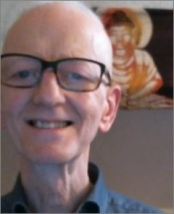 As it happened, I (Jim) did manage to find my way out of the darkness and confusion; out of the autism and dissociation; out of the fear and loneliness. I did my therapy, and I got my reward!
Now I write books for others on the subject of how to overcome childhood developmental trauma.
~~~
The new book on Childhood Developmental Trauma should be available at Amazon outlets in the next month or so, (because I keep getting distracted onto urgent survival projects).
Best wishes,
Jim
Dr Jim Byrne, Doctor of Counselling
ABC Coaching and Counselling Services
The Institute for Emotive-Cognitive Embodied Narrative Therapy
~~~
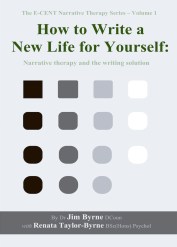
 In this blog I want to outline some of the invaluable benefits of writing about yourself and your life, and then briefly explain some of the writing strategies recommended and described in Jim Byrne’s book: “How to Write a New Life for Yourself: narrative therapy and the writing solution”.
 Secondly, the benefits of the writing therapy process have been scientifically assessed. It’s worth knowing that there are very real benefits to our bodies and minds which have been systematically researched: The benefits of writing things out of our system was investigated by Dr James Pennebaker of the University of Texas. He thinks that regular writing (he calls it ‘journaling’) strengthens our immune cells, called T-lymphocytes. Other research has shown that regular writing reduces the symptoms of asthma and rheumatoid arthritis. Pennebaker also believes that writing about stressful events helps you come to terms with them, and this means a reduction in the impact of these stressors on your physical health.
 Jim Byrne’s book has a section which can help you if you feel unable to start the writing process, and he describes the different life transitions which he used on his own writing therapy, and which he has used for many years to help his clients heal and deepen their understanding of their lives. He describes the main life stories as: ‘The story of my origins”, “The story of my relationships” (especially your relationship with your mother), “The story of transitions” and the “Story of career difficulties”. He also describes the starting points used by other therapists, for example Noppe-Brandon (2018) who focusses on life stages.
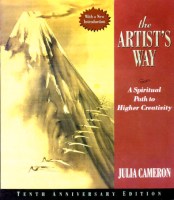 “Julia Cameron (1992) teaches a daily writing process that is designed to help the writer recover a sense of safety and identity; a sense of power and integrity; a sense of possibility and abundance; a sense of connection and strength; a sense of compassion and self-protection. These goals are achieved by writing three pages of ‘streams of consciousness’ each day.”
  Renata Taylor-Byrne
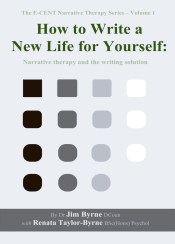 This very simple but highly therapeutic process is described in our book titled:
  In her work on therapeutic writing, Julia Cameron (1992) uses several metaphors and similes to try to communicate what her readers and students can gain from using her system of therapeutic writing.
 ABC Coaching and Counselling Services
 I believe that each of us is a silent witness of our early childhood experiences. We do not know what happened to us unless and until somebody helps us to make a story or stories out of our raw experiences.
 I met Carla in Bangladesh, and she was intensely curious about my life, and especially my childhood. I told her some bits and pieces from the very edges of my conscious awareness, and she was appalled at how painful my childhood had been – how physically and emotionally I’d been abused. I was amazed at the emotions that came up them: the painful memories that welled back. What I had taken to be ‘normal life’ turned out to be quite brutally unusual – or at least not how children should be raised, by parents who love their children, and want them to be happy.
 Over time, two major stories emerged: My Story of Origins (as a country boy in a city school, who failed to make a single friend in ten years of schooling). And My Story of Relationship (especially my insecure attachment to my cruel mother). Both of these stories now appear in a forthcoming book, which you can read about here:
 Over a period of more than 22 years of professional practice, Dr Jim Byrne has developed and refined a DIY (self-help) approach to resolving your own childhood trauma. This book will help you to understand what childhood developmental trauma is; how it relates to insecure attachment and dysfunction of the right brain; and how to work on childhood trauma using a whole body, brain, mind approach. This book outlines three major therapeutic processes, at three graded levels of emotional disturbance (from mild to intense), which you can progressively (and slowly and gradually) work through, in the form of journal writing, and related processes of body-awareness, body activity, sleep, diet and exercise solutions, and deep relaxation.
 That’s all for today.
 ABC Bookstore Online UK