Dr Jim’s Blog post
23rd April 2020
~~~
Books as depositories of valuable knowledge and ideas; and as outlets for speaking to the world…
~~~
Introduction
 I love books; and I’ve enjoyed scouring bookshops for new ideas since I was about 14 years old. It is perhaps one of the greatest deprivations of the Covid-19 lockdown that I cannot get to walk around the philosophy, psychology, health and self-help sections of Waterstones, in Leeds or Manchester; or the Bookcase in Hebden Bridge; or W.H. Smith’s in Halifax; or the Bookcase store in Piece Hall.
I also miss the whole floor of good quality, and interesting secondhand books in Oxfam in Bradford!
~~~
~~~
A story of browsing
Yesterday I was browsing my own (and Renata’s) bookshelves in our attic office when my mind alighted upon one of our own books – Holistic Counselling in Practice: An Introduction to Emotive-Cognitive embodied Narrative Therapy.[1]
 But, actually, it was the original version I had in my hands; the one with the bnlue cover, and the coloured illustrations – and my eyes were drawn to three illustrations, on pages vi and vii of the Foreword.
– The first illustration shows the interaction of a mother and baby, giving rise to the socialized mind of the child.
(See below).
– The second is a blue boxed callout, which says: “We are bodies as well as minds; primarily social animals; with the potential to develop virtues and vices”.
(Not shown on this page).
~~~
– And the third was also a callout, like this:
“The thoughts and beliefs of the (counselling) client cannot exist independently of their diet, exercise, self-talk, relaxation, stress level, social and economic circumstances, etc.”

With the benefit of the passage of time, I can see that sleep and relaxation should have featured prominently in that second callout.
Anyway, the surprising thing was that I had to skim all the way through to page 123 before I could find our Holistic SOR model, which is what distinguishes us from the CBT, psychodynamic and humanistic traditions. This is it:

This model shows that diet and food supplements; meditation; exercise regime; plus sleep and relaxation histories; are among the many factors which determine how the body-brain-mind will respond to an incoming stimulus, or, if you like: how we will respond to our ongoing experiences.
The importance of high quality, original research
I recall that, as I was beginning to draft that book, I realized that we needed to be quite specific about the kinds of foods, and exercise systems, that would most benefit a person who is suffering from anger management issues, or anxiety/panic, or depression. And I knew I could not afford the time to study nutrition and exercise at that time; so I spoke to Renata (my wonderful wife and life and business partner) and she agreed to do what turned out to be months of research of the scientific studies which have looked at the links between diet and exercise, on the one hand, and the experience of anger, anxiety and/or depression, on the other.
Renata’s research of those subjects appeared as Appendices E and F of the Holistic Counselling book; and later we created a more expanded book – Lifestyle Counselling and Coaching for the Whole Person – in which Renata did weeks of research on the science of sleep, and how it relates to emotional states; and that went into the Lifestyle Counselling book.
Recently, we’ve gone back to all of that research, and subsequent refinements, to produce a new book.
This time we’ve tackled a topic which is very relevant to the Covid-19 pandemic: how to control your anxiety. Here are the details of the book:
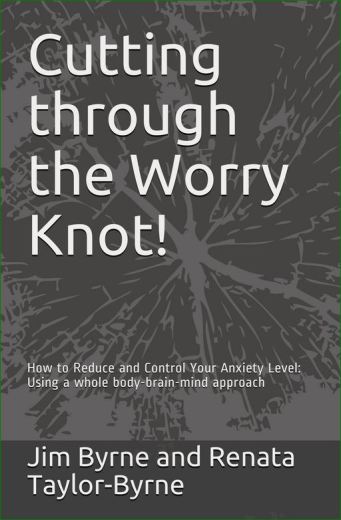 Cutting through the Worry Knot!
How to Reduce and Control Your Anxiety Level: Using a whole body-brain-mind approach
And without using drugs, alcohol or escapism!
By Dr Jim Byrne and Renata Taylor-Byrne
Anxiety is not a disease; not a mental illness. Anxiety is part of our normal, innate, mental signalling system which tells us what is happening to us, and what to do about it. That is to say, it is part of our emotional wiring. Our emotional intelligence.
Trying to get rid of anxiety with drugs is like hanging two overcoats and a duvet over your burglar alarm when it goes off. The burglar alarm is designed to give you helpful information, which you can then use to guide your action. Should you check to see if a burglar has got into your house? Or call the police? Or realize that you’d mismanaged your alarm system, and that you should therefore switch it off?
Once you understand anxiety correctly, it becomes as useful as a burglar alarm; and you can learn how to manage it correctly.
When you buy a burglar alarm, it comes with a little Instruction Book about how to set it; calibrate it; monitor it; reset it; and switch it on and off.
You should have got just such an Instruction Book about your anxiety alarm, from your parents, when you were very young – and some people did. But if your alarm goes off at all times of day and night, in unhelpful ways, then I guess you were one of the unlucky ones who did not get your Instruction Book. This book contains your Instruction Book, plus lots of other backup information, which will help to make you the master of your anxiety, instead of its quaking slave.
Don’t let your anxiety “burglar alarm” reduce your life to misery. Learn how to use it properly!
For more information about this book on anxiety:
~~~
Paperback copy:
~~~
Kindle eBook copy:
~~~
We love books: Reading them; writing them; and talking about them. We hope you enjoy what we have to say about what we have learned, and how we have applied our learning.
~~~
Best wishes for a happy reading aspect to your growing life!
 Jim
Jim
Dr Jim Byrne
Doctor of Counselling
Joint Director of the ABC Bookstore Online UK
Joint Director of the Institute for E-CENT Counselling
Dr Jim’s Counselling and Psychotherapy Division
~~~
~~~
[1] Byrne, J.W. (2019) Holistic Counselling in Practice: An introduction to the theory and practice of Emotive-Cognitive Embodied-Narrative Therapy. Updated edition (2). Hebden Bridge: The Institute for E-CENT Publications.
~~~
Byrne, J.W. (2018) Lifestyle Counselling and Coaching of the Whole Person: Or how to integrate nutritional insights, physical exercise and sleep coaching into talk therapy. Hebden Bridge: The Institute for E-CENT Publications.
~~~
Taylor-Byrne, R.E. and Byrne, J.W. (2017) How to control your anger, anxiety and depression, using nutrition and physical activity. Hebden Bridge: The Institute for E-CENT Publications.
~~~
Byrne, J.W. and Taylor-Byrne, R.E. (2020) Cutting through the Worry Knot! How to Reduce and Control Your Anxiety Level: Using a whole body-brain-mind approach. Hebden Bridge: The Institute for E-CENT Publications.

 “In 2026, I resolve to nurture my mental and emotional health by seeking out practical self-help strategies and dedicating time each week to personal growth and healing.”

 Renata Taylor-Byrne’s book explores using progressive muscle relaxation to combat anxiety, citing a case study of a college student haunted by fears rooted in a family tragedy. After receiving therapy and implementing relaxation exercises, she overcame her fears and excelled academically abroad. This approach proved more effective than medication or cognitive behavioral therapy. The case highlights the efficacy of addressing mental issues through physical means, demonstrating the power of body-mind connection in alleviating anxiety. For more details, refer to “Relax and Enjoy It!” by Renata Taylor-Byrne.
 In the preface to her book on how to do progressive muscle relaxation, Renata Taylor-Byrne wrote about a couple of case studies where muscle relaxation was used to effectively overcome intense anxiety. This is one of those case studies:

 ABC Bookstore Online UK