

Blog post on 2nd July 2024
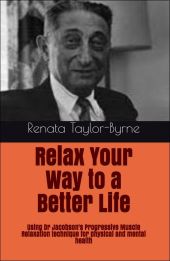
 Renata Taylor-Byrne’s book explores using progressive muscle relaxation to combat anxiety, citing a case study of a college student haunted by fears rooted in a family tragedy. After receiving therapy and implementing relaxation exercises, she overcame her fears and excelled academically abroad. This approach proved more effective than medication or cognitive behavioral therapy. The case highlights the efficacy of addressing mental issues through physical means, demonstrating the power of body-mind connection in alleviating anxiety. For more details, refer to “Relax and Enjoy It!” by Renata Taylor-Byrne.
How progressive muscle relaxation could cure your anxiety problems
 In the preface to her book on how to do progressive muscle relaxation, Renata Taylor-Byrne wrote about a couple of case studies where muscle relaxation was used to effectively overcome intense anxiety. This is one of those case studies:
~~~
A college student had been plagued for a long time by fears of the dark; being on her own; and of fires breaking out, and harming her. Part of the cause was this: Her aunt had been killed in a fire three years earlier, and when she (this young student) tried to get to sleep each night, she had very strong images of scorching fires, and people in flames. This was obviously why she found it very hard to sleep at night; and she felt so vulnerable that she had to have someone in the room while she slept; and she had to have the room illuminated all night. (This case is described in a book by Bernstein, Borkovec and Hazlett-Stevens, 2000, Page 18, also in the References list, below).
 Eventually she went to see a therapist, and told the therapist that she had to go and study in another country in seven weeks’ time. She didn’t think she could handle the stress of the travel and the new location, and would have to drop out of the study programme.
How could this student handle the necessary changes needed for her to be able to continue with her academic commitments abroad?
A physical solution for a mental problem
The therapist treated her with progressive muscle relaxation training (in a shortened form, similar to that in Chapter 10, because of lack of time), and she practised the exercises twice a day herself; the second session each day being at her bedtime. As well as the daily relaxation sessions, she was instructed to gradually reduce the light level in her room – over a period of many days – and to do her second relaxation session in bed before her roommate came in.
The procedure she was following was designed to enable her to become slowly adapted to more challenging situations, which she had previously feared – (a dark room, with no-one else in it) – and she was experiencing these situations in a very relaxed state.
She carefully followed the therapist’s instructions, and, by the time of the third interview, she was able to announce that her fears had greatly diminished, because of her growing skill at using the prescribed exercises to relax her body and mind, and to bring on sleep. Her training sessions and ‘in vivo’ practice[1] – (the gradually darkening room and her increasing ability to feel comfortable going to sleep in a room on her own) – had paid off!
Anti-anxiety medication and CBT would not have produced such radical results. Working through the body is one of the best ways of calming the mind!
~~~
To read more about this book, please go here: Relax and Enjoy It!
~~~
Jim Byrne, Doctor of Counselling
Executive Director of the ABC Bookstore
~~~
~~~
Footnote from above
[1] In behaviour therapy, ‘in vivo exposure’ means directly facing a feared object, situation or activity in real life; which, in the example above, means facing up to the fear of being alone in an increasingly darkened room.



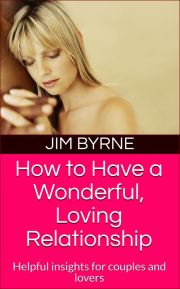
 Is there one book that could solve all of your problems, for the whole of your life?
 ~~~
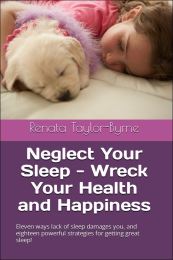
~~~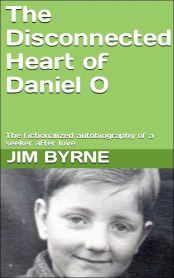 Our mothers have the most dramatic effect upon our psychical and mental health, and upon our life chances. So choose your mother carefully!
 Best wishes,
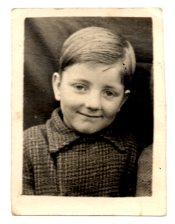 Writers are people who write.
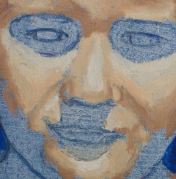 Vasha Popov screwed his little face up, like a well-squeezed dishcloth. He stared into the big, mottled mirror, looking for the echo of his facial contortions. And there it was. This was him. This blue face, with the sad calf eyes and the downturned mouth. And there in the apparent ugliness of his blue face was the evidence, it seemed, of why Mamu did not let him touch her, or speak to her, or get close to her.
 Jim
Jim Having spent almost twenty-five years working with counselling clients with some degree of trauma, from childhood or later periods of their lives, I have written my experience up in the form of a low-cost self-help book.
 Traumatic memories are painful, and so the vast majority of people are highly reluctant to face them down. To suggest to most people that they should revisit their traumatic memories would seem to be a form of madness; a kind of masochism on the part of the traumatized individual, and a form of sadism on the part of the trauma therapist. Why face up to a dragon when you can hide?!?
 This book could help you to resolve some of your own traumatic experiences, or it could help you to help somebody else to recover.
 ABC Bookstore Online UK