
Diet and exercise affect mental health

Blog post: 4th July 2019

~~~

Diet and exercise are at least as important as philosophy of life in determining how we feel!

~~~

Copyright (c) Jim Byrne, Doctor of Counselling, July 2019

~~~
Front cover design 3Over the years that I’ve been providing counselling and therapy services to individuals and couples, I have had to keep broadening my understanding of the nature of human beings.

I was originally trained as a Rational Therapist (REBT), and tended to focus exclusively on the self-talk of the client.  I had bought into the idea that people are upset by what they “tell themselves” about their negative experiences.

Then I came across clients who did not seem to have any obvious psychological reason to feel depressed or anxious, but they were. This led me to realize that many people suffer from ‘gut dysbiosis’, including Candida Albicans overgrowth, which (we now know) also causes ‘leaky brain’, which allows toxins from the large intestine to get into the bloodstream, and from there, into the brain; disrupting brain chemistry, and causing symptoms of anxiety, depression, in the main; but theoretically also, anger.

Dr-Jim-Byrne8 (2)I also found that some people were anxious because they were over-consuming caffeine or sugary foods; and not consuming enough calming foods and drinks (like Brazil nuts, and Camomile tea).

Out of these realizations, and others, I began to build, and to constantly amend, my own stress and anxiety diet, which I shared with my clients, when appropriate.

And some clients had such sedentary lifestyles that they became anxious or depressed, because of the lack of exercise-induced production of endorphins (or ‘happiness chemicals’); and exercise-assisted washing of stress hormones out of their systems.

Jim.Nata.Couples.pg.jpg.w300h245 (1)Eventually, Renata, my wife and professional partner, did some research on the role of diet and exercise in the experience of anger, anxiety and depression; and we collaborated on a book in which we put her research, and my stress and anxiety diet, together; plus some work we’d jointly done on exercise.

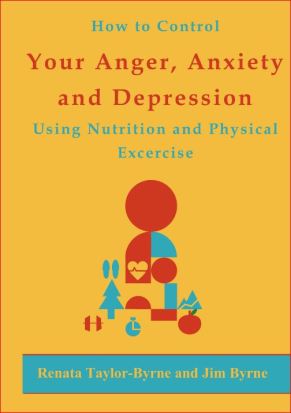
The book is titled, How to Control Your Anger, Anxiety and Depression: Using nutrition and physical activity.***

~~~

There are six parts to this book:

Front cover design 3The first part deals with diet and nutrition and how they influence anxiety, anger and depression.

The second part of the book deals with physical exercise and how it can affect these common emotional problems.

The third part is a description of my ‘stress and anxiety reduction diet’ and offers guidelines for understanding different types of diets and their effects.

The fourth part shows some of the key findings from the science of nutritional deficiency, and the role of inflammation in the creation of depression.

The fifth part is a summing up of the key findings of the book, so that you can spot the most useful material that you can use for yourself – or for your clients, if you are a health-care or psychotherapeutic practitioner, counsellor or psychologist.

And the sixth part is our attempt to coach you through the process of habit change (including controlling alcohol consumption; changing your diet; or increasing your physical activity); and to give you a map to guide you through the process of accessing, learning and applying the transformative information in this book.

You can read a page of information about this book here:

https://abc-bookstore.com/diet-exercise-mental-health/

~~~

Sleep and quality of life

Blog post – 5th July 2019 –

Updated on 30th July 2021

~~~

Do you know why great quality of life and sufficient sleep go hand in hand?

By Renata Taylor-Byrne (Copyright 2019)

~~~

Introduction

Sleep & Health book, Front coverSome people, like Donald Trump, denigrate the value of sleep, and try to get by with five hours per night.  But more developed minds take a very different view:  For example, Warren Buffet has said:

“When forced to choose, I will not trade even one night’s sleep for the chance of extra profit.

The good news I want to remind you of, (which you may not be aware of), is that there are some wonderful, strengthening things that happen to your body and mind when you have sufficient sleep:

It keeps your weight down and reduces cravings for food.

It improves your memory and makes you more creative.

It lowers your risk of heart attacks and stroke.

It protects you from dementia and cancer.

It makes you look more attractive.

It helps you protect yourself from colds and flu.

Sleeping babyYou feel happier and less depressed and anxious.

But where’s the evidence? you might ask.

And my reply is this, taken from Matthew Walker – (Why We Sleep, 2017) – who has been researching sleep for over twenty years:

“The evidence supporting these claims (above) has been documented in more than 17,000 well-scrutinised scientific reports to date.”

And here’s the bad news: if you don’t take your sleep needs seriously, then here are some of the negative consequences of insufficient sleep:

Your emotional intelligence plummets, as does your ability to have empathy for others. Furthermore the motivation levels of employees are reduced by sleep-deprived managers.

Sleep & Health book, Front cover

Your appetite and weight level increases.

Your immune system is weakened.

Cardio-vascular health is very negatively affected.

Emotions fluctuate. With lack of sleep, your prefrontal cortex (or conscious brain-mind) stops working effectively, and you become more emotionally volatile, making rash choices and irrational decisions.

Fertility reduces.

Moments of absolute unconsciousness (called ‘Micro-sleeps’) take place, whether you are driving or standing still; or operating machinery; creating dangers for yourself and others.

Your ability to memorize new information plummets.

For more information on the vital importance of having sufficient sleep, and how to obtain it, please follow this link: https://abc-bookstore.com/sleep-better-feel-better/

~~~

Nata-Lifestyle-coach8That’s all for now.

I hope you find this helpful, and have a good night’s sleep! 🙂

Best wishes,

Renata

Renata Taylor-Byrne

Coach-Counsellor, at ABC Coaching and Counselling Services.

Email: renata@abc-counselling.org

Telephone: 01422 843 629 (UK: +44)

~~~

Diet and exercise affect mental health

Blog post: 4th July 2019

~~~

Diet and exercise are at least as important as philosophy of life in determining how we feel!

~~~

Copyright (c) Jim Byrne, Doctor of Counselling, July 2019

~~~

Diet,exercise book coverOver the years that I’ve been providing counselling and therapy services to individuals and couples, I have had to keep broadening my understanding of the nature of human beings.
I was originally trained as a Rational Therapist (REBT), and tended to focus exclusively on the self-talk of the client.  I had bought into the idea that people are upset by what they “tell themselves” about their negative experiences.

Then I came across clients who did not seem to have any obvious psychological reason to feel depressed or anxious, but they were. This led me to realize that many people suffer from ‘gut dysbiosis’, including Candida Albicans overgrowth, which (we now know) also causes ‘leaky brain’, which allows toxins from the large intestine to get into the bloodstream, and from there, into the brain; disrupting brain chemistry, and causing symptoms of anxiety and depression, in the main; but theoretically also, anger; and who know what not.

I also found that some people were anxious because they were over-consuming caffeine or sugary foods; and not consuming enough calming foods and drinks (like Brazil nuts, and Camomile tea).

Out of these realizations, and others, I began to build, and to constantly amend, my own stress and anxiety diet, which I shared with my clients, when appropriate.

And some clients had such sedentary lifestyles that they became anxious or depressed, because of the lack of exercise-induced production of endorphins (or ‘happiness chemicals’); and exercise-assisted washing of stress hormones out of their systems.

Eventually, Renata, my wife and professional partner, did some research on the role of diet and exercise in the experience of anger, anxiety and depression; and we collaborated on a book in which we put her research, and my stress and anxiety diet, together; plus some work we’d jointly done on exercise.

The book is titled, How to Control Your Anger, Anxiety and Depression: Using nutrition and physical activity.***

~~~

There are six parts to this book:

Diet,exercise book coverThe first part deals with diet and nutrition and how they influence anxiety, anger and depression.

The second part of the book deals with physical exercise and how it can affect these common emotional problems.

The third part is a description of my ‘stress and anxiety reduction diet’ and offers guidelines for understanding different types of diets and their effects.

The fourth part shows some of the key findings from the science of nutritional deficiency, and the role of inflammation in the creation of depression.

The fifth part is a summing up of the key findings of the book, so that you can spot the most useful material that you can use for yourself – or for your clients, if you are a health-care or psychotherapeutic practitioner, counsellor or psychologist.

And the sixth part is our attempt to coach you through the process of habit change (including controlling alcohol consumption; changing your diet; or increasing your physical activity); and to give you a map to guide you through the process of accessing, learning and applying the transformative information in this book.

You can read a page of information about this book here:

https://abc-bookstore.com/diet-exercise-mental-health/

~~~

That’s all for now. If you buy the book, I hope you find it a helpful resource, and that you enjoy it.

Best wishes,

Jim

Dr Jim Byrne, Doctor of Counselling

Email: jim.byrne@abc-counselling.com

~~~


Albert Ellis blames his golfing client for his emotional upset

Blog Post – 2nd July 2019

~~~

Albert Ellis and the Unhappy Golfer: A critique of the simplistic ABC model of REBT

by Jim Byrne

~~~

Front cover, Ellis and the Golfer3In his 1962 book, introducing Rational Therapy to the world, Dr Albert Ellis presented his now famous – or infamous (in my view) – ABC model. When Ellis uses this model with an unhappy golfer – who came to him because he was unhappy about the fact that his golfing peers did not like him –  he uses it to claim that the golfer “upset himself”, rather than being upset by the fact that his golfing peers clearly did not like him.

Ellis has railed against Sigmund Freud, and claimed his Rational Therapy work to be a great step up from Freud’s theory; but what they both have in common is a kind of ABC model.  Ellis’s is explicit.  Freud’s is implicit.  Freud (in the parts of his work that I have reviewed) argued that his patients were not upset (or neurotic) because of their family of origin, but because of their ‘phantasies’ about members of their family and others.  In other words: A = Actual social environment.  B = beliefs or phantasies. And C = neurotic (emotional and/or behavioural) consequence.

But what Ellis and Freud overlook is this: The ego (or personality) of the client is created out of years of cumulative, interpretive experience of being treated in specific ways by mother and father, and others.

And Ellis takes none of this into account in trying to understand why his golfing client might be upset (or terribly unhappy) about being rejected (or not liked) by his golfing peers.

We are not ‘belief machines’, as Ellis thought.  We are much more complex than that. For example: Our brain creates an internal map (or movie) of every aspect of our felt, physical existence, (and our feelings about those sensations), which is managed from an area of the brain called the insula.  According to Giulia Enders (2015), “It may be time to expand René Descartes’ proposition along these lines: ‘I feel, then I think, therefore I am’.” (Page 133).

We were feeling beings from the beginning.  Our socialization and education added on aspects of thinking to our feeling nature; but we continue to be feeling beings.

Ellis claimed to be influenced by John Dewey.  However, John Dewey, a famous American philosopher/ psychologist/ educationalist, published a book, titled ‘The Need for Social Psychology’, in 1917[1]. And in this book, he describes humans as “social animals”.  More specifically, Dewey wrote that, in social psychology, “our problem” is two-fold:

(1) “…to know the modifications (brought about) in the (brain/mind) of (humans) by the fact that the elements of (human) endowment operate in this or that social medium”; and:

(2) “on the other hand, we want to know how control of the environment may be better secured by means of the operation of this or that native capacity”.

In other words, we want to understand the interactions of organism-and-environment – or the B (where B = body-mind) and the A (or environment) – as a bi-directional process[2].

But Ellis relates to his golfing client as a unidirectional ‘individual’, responsible for his own shape and form; his own feelings and attitudes; as if he had fallen from the sky!

And the ‘therapeutic environment’ that Ellis provides for his client is highly directive, ‘controlling parent’, which is most likely to promote the emergence of either a conforming child ego-state, or a rebellious child ego-state; neither of which is going to work very well on the golf course of tomorrow!

It would have been much more helpful if he’d contrived to produce an environment (in the therapy room), for the unhappy golfer, which evoked a growing adult ego-state; a seeker after self-correction (of any social-relationship errors; and so on).

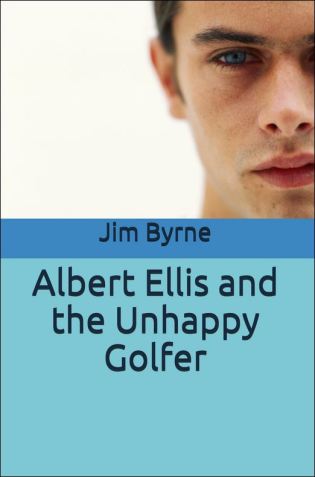
I have written in detail about the mistakes Albert Ellis made in dealing with his golfing client, in my recent book, Albert Ellis and the Unhappy Golfer.***

Please take a look at this page of information.

Best wishes,

Jim

Dr Jim Byrne, Doctor of Counselling

https://abc-counselling.org

https://abc-bookstore.com

https://ecent-institute.org

~~~

Endnotes:

[1] Dewey, J. (1917) ‘The Need for Social Psychology.’  Psychological Review, 24 (1917): 266-277.

[2] Dewey (1917) wrote: “Henceforth it is, I submit, pure wilfulness if any one pretending to a scientific treatment starts from any other than a pluralistic basis: the complexity and specific variety of the factors of human nature, each operating in response to its own highly specific stimulus, and each subject to almost infinite shadings and modulations as it enters into combination and competition with others. The conception of social psychology resulting from this mode of approach becomes essentially one with that set forth by Professor W. I. Thomas in his paper on the province of social psychology at the St. Louis Congress of Arts and Science in 1904. On the one hand our problem is to know the modifications wrought in the native constitution of man by the fact that the elements of his endowment operate in this or that social medium; on the other hand, we want to know how control of the environment may be better secured by means of the operation of this or that native capacity. Under these general heads are summed up the infinity of special and difficult problems relating to education on the one hand and to constructive modification of our social institutions on the other. To form a mind out of certain native instincts by selecting an environment which evokes them and directs their course; to re-form social institutions by breaking up habits and giving peculiar intensity and scope to some impulse is the problem of social control in its two phases. To describe how such changes take place is the task of social psychology stated in generalized terms.”

lifestyle counselling and coaching

Blog post – 2nd July 2019

~~~

Lifestyle Counselling deals with the whole person

The Lifestyle Counselling BookMost systems of traditional talk therapy only deal with the ‘mind’ of the client, and the language function. Gestalt therapy deals with the body in terms of muscle tension; and Multimodal therapy allows for the effects of drugs and medicines on the body-mind.  But up to very recently – when E-CENT counselling created Lifestyle Counselling as a comprehensive, holistic practice – counsellors did not take account of the diet of the client; how well they slept; how much exercise they did; and so on.

On 17th March 2018, we published our book, Lifestyle Counselling and Coaching for the Whole Person: Or how to integrate nutritional insight, exercise and sleep coaching into talk therapy It began selling immediately, and has continued to do so.  Books do not normally sell so well via social media publicity.  So why is this one selling so well, on a steady basis?

The answers can be summarized like this:

  1. Lifestyle counselling is an idea whose time has come!
  1. Some bright counsellors can see that this is the future of counselling and psychotherapy.
  1. It is now obvious that the counselling client is a body-brain-mind in a social-economic-environment. Not a talking head!

So things have begun to change.  It is less than twenty years since the emotional revolution overtook the cognitive revolution. And it is less than ten years since the first signs of nutritional psychiatry began to emerge.  And it is less than 2 years since the first book on Holistic Counselling in Practice emerged: dealing with diet, exercise, self-talk, attachment, affect regulation, relaxation and sleep science.

This is the future of counselling.  This is the emerging revolution.  Join us.  Take a look at lifestyle counselling and coaching for the whole person…

That’s all for now.

Best wishes,

Jim

Dr Jim Byrne, Doctor of Counselling

https://abc-counselling.org

https://abc-bookstore.com

https://ecent-institute.org

~~~